Question 1 of 10
The graph shows the change in a moth population over time. Dark moths increased after industrial pollution darkened tree bark. This is an example of:
ANatural selection
BSpontaneous generation
CArtificial selection
DGenetic engineering
Explanation
📌 This is the classic peppered moth example of natural selection.
Before pollution: light bark → light moths camouflaged → survived
After pollution: dark bark → dark moths camouflaged → survived
The environment selected for the trait that provided camouflage.
Before pollution: light bark → light moths camouflaged → survived
After pollution: dark bark → dark moths camouflaged → survived
The environment selected for the trait that provided camouflage.
Question 2 of 10
A rabbit's strong hind legs allow it to escape predators by running quickly. This is BEST classified as which type of adaptation?
AMimicry — resembling another organism for defense
BBehavioral — an inherited action pattern the animal performs
CPhysiological — an internal chemical or metabolic process
DStructural — anatomical feature inherited and present in the body
Explanation
The rabbit's hind legs are an anatomical body feature — a structural adaptation. Structural adaptations are physical body parts (legs, claws, fur, beaks) inherited through generations. Distractors: Behavioral would be the act of running away (a pattern of action), not the legs themselves. Physiological refers to internal processes like blood pressure or hormone release, not external anatomy. Mimicry is a specific case where one organism resembles another for defense, which doesn't apply here.
Question 3 of 10
All three domains of life (Bacteria, Archaea, and Eukarya) share which structural feature?
AA membrane-bound nucleus
BMulticellular organization
CChloroplasts for photosynthesis
DRibosomes for protein synthesis
Explanation
All cellular life — Bacteria, Archaea, and Eukarya — uses ribosomes to build proteins. Distractors: a membrane-bound nucleus is found only in Eukarya (Bacteria and Archaea are prokaryotic). Multicellularity appears only in some Eukarya — most life is unicellular. Chloroplasts are organelles found only in plants and algae (a subset of Eukarya).
Question 4 of 10
The image shows lab equipment. Which is used to measure precise volumes of liquid? 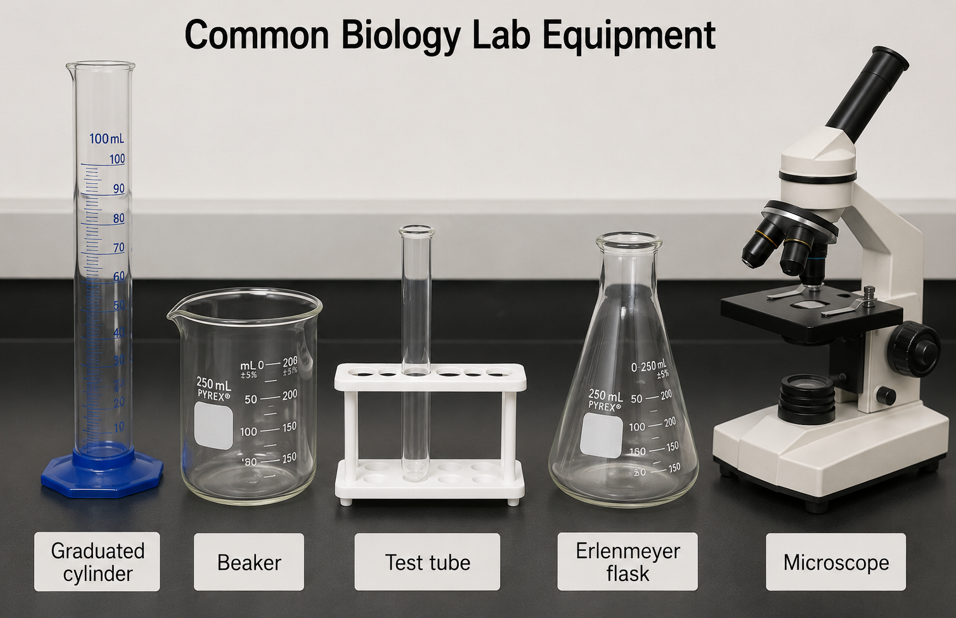
ABeaker
BGraduated cylinder
CErlenmeyer flask
DTest tube
Explanation
A graduated cylinder is designed for accurate volume measurement (markings are precise). Beakers and flasks are for rough volumes only.
Question 5 of 10
The image shows the taxonomic hierarchy. Which level contains organisms most similar to each other? 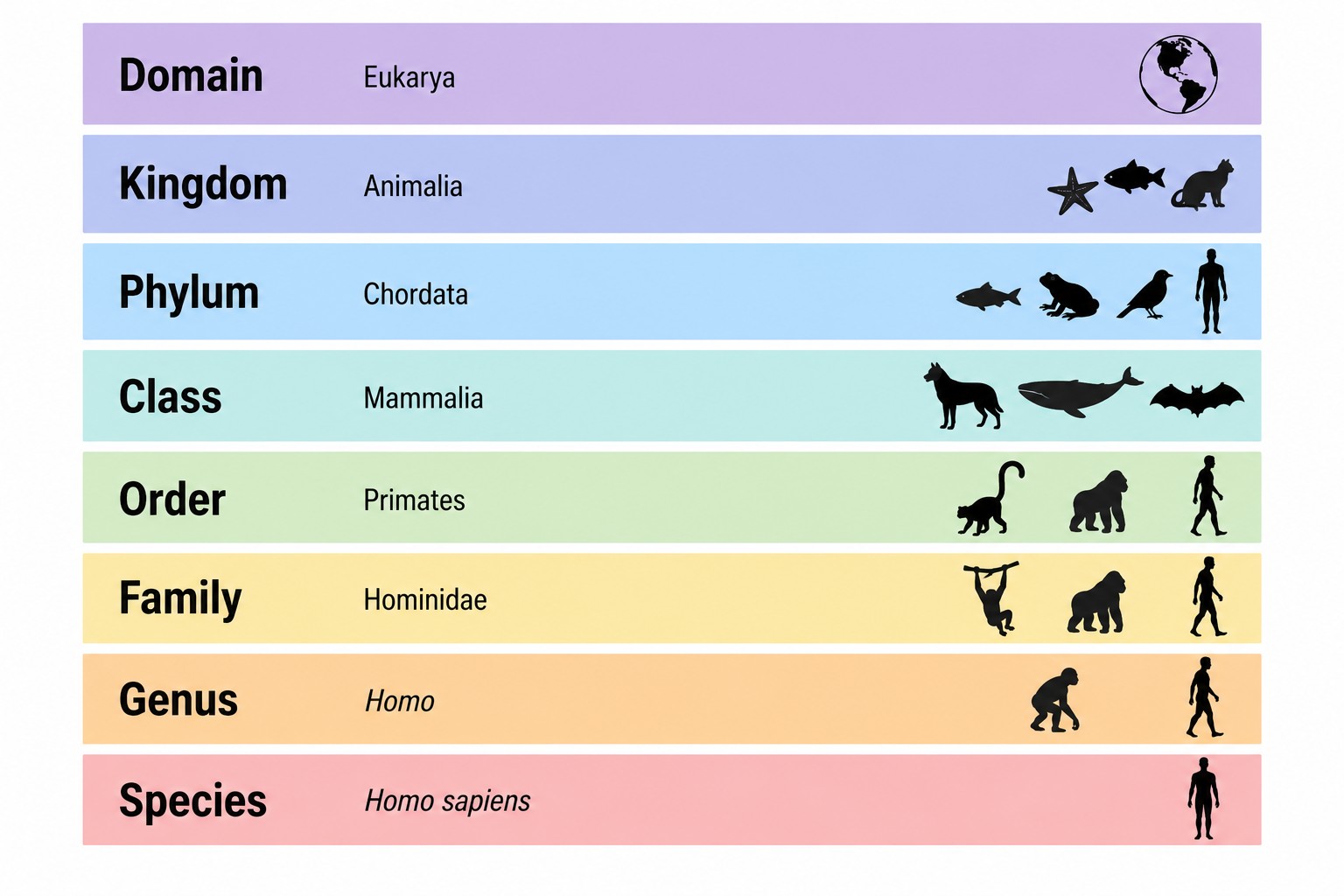
ADomain
BKingdom
CClass
DSpecies
Explanation
Species is the most specific (narrowest) level — organisms in the same species can interbreed and produce fertile offspring.
Question 6 of 10
Which graph correctly shows exponential growth?
AB
BNeither
CA
DBoth
Explanation
📌 Exponential growth = J-shaped curve (slow start, rapid increase)
Linear growth = straight line (constant rate)
Graph A shows exponential growth.
Linear growth = straight line (constant rate)
Graph A shows exponential growth.
Question 7 of 10
Which organelle is labeled X in the cell diagram below? 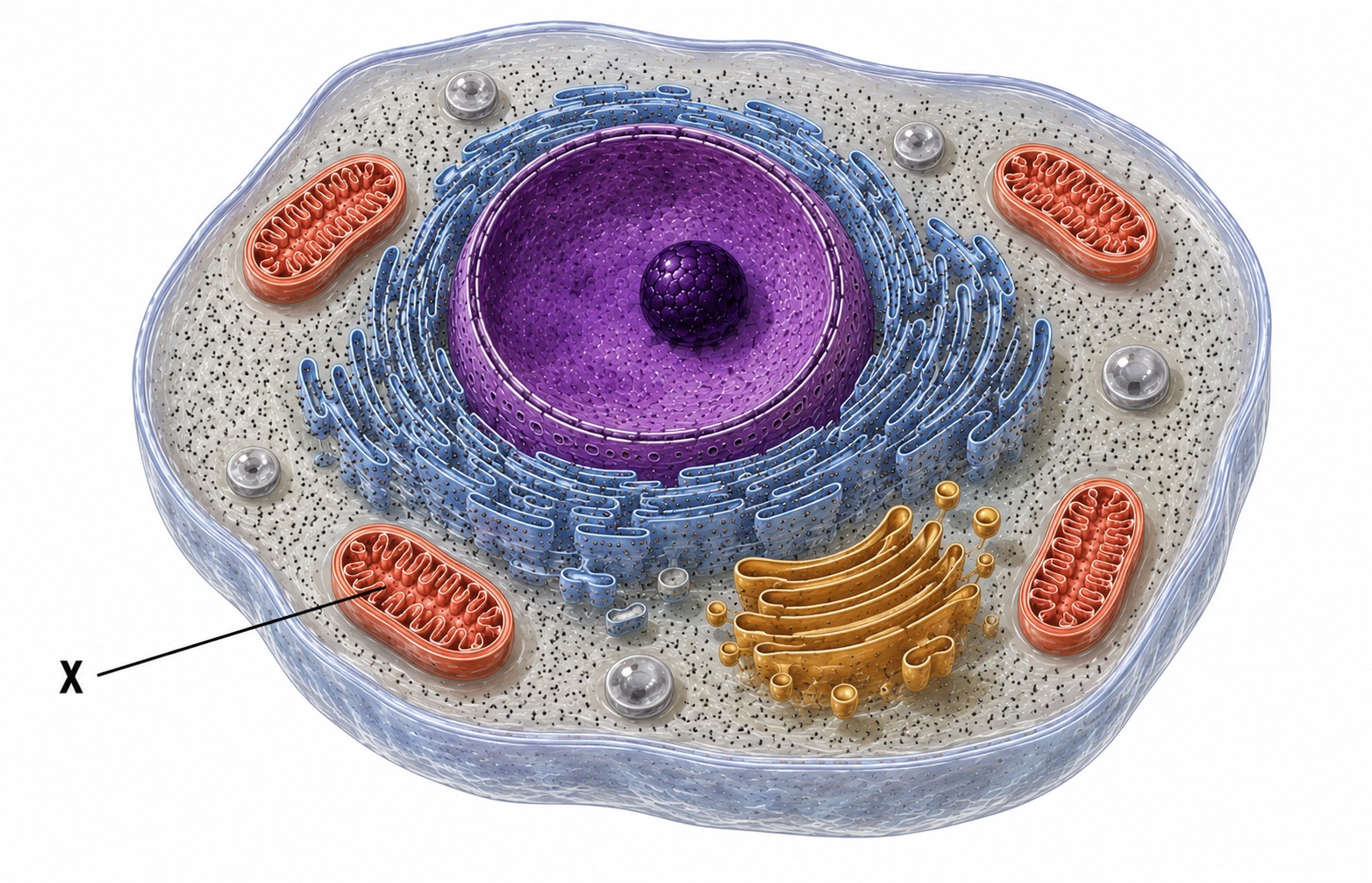
AEndoplasmic reticulum
BGolgi apparatus
CNucleus
DMitochondria
Explanation
📌 Organelle X has the bean-shaped structure with inner folds (cristae) → Mitochondria
Mitochondria = powerhouse of the cell = produces ATP through cellular respiration
C₆H₁₂O₆ + 6O₂ → 6CO₂ + 6H₂O + ATP
Mitochondria = powerhouse of the cell = produces ATP through cellular respiration
C₆H₁₂O₆ + 6O₂ → 6CO₂ + 6H₂O + ATP
Question 8 of 10
The diagram shows the three domains of life. Which domain contains organisms with no membrane-bound nucleus and lives in extreme environments?
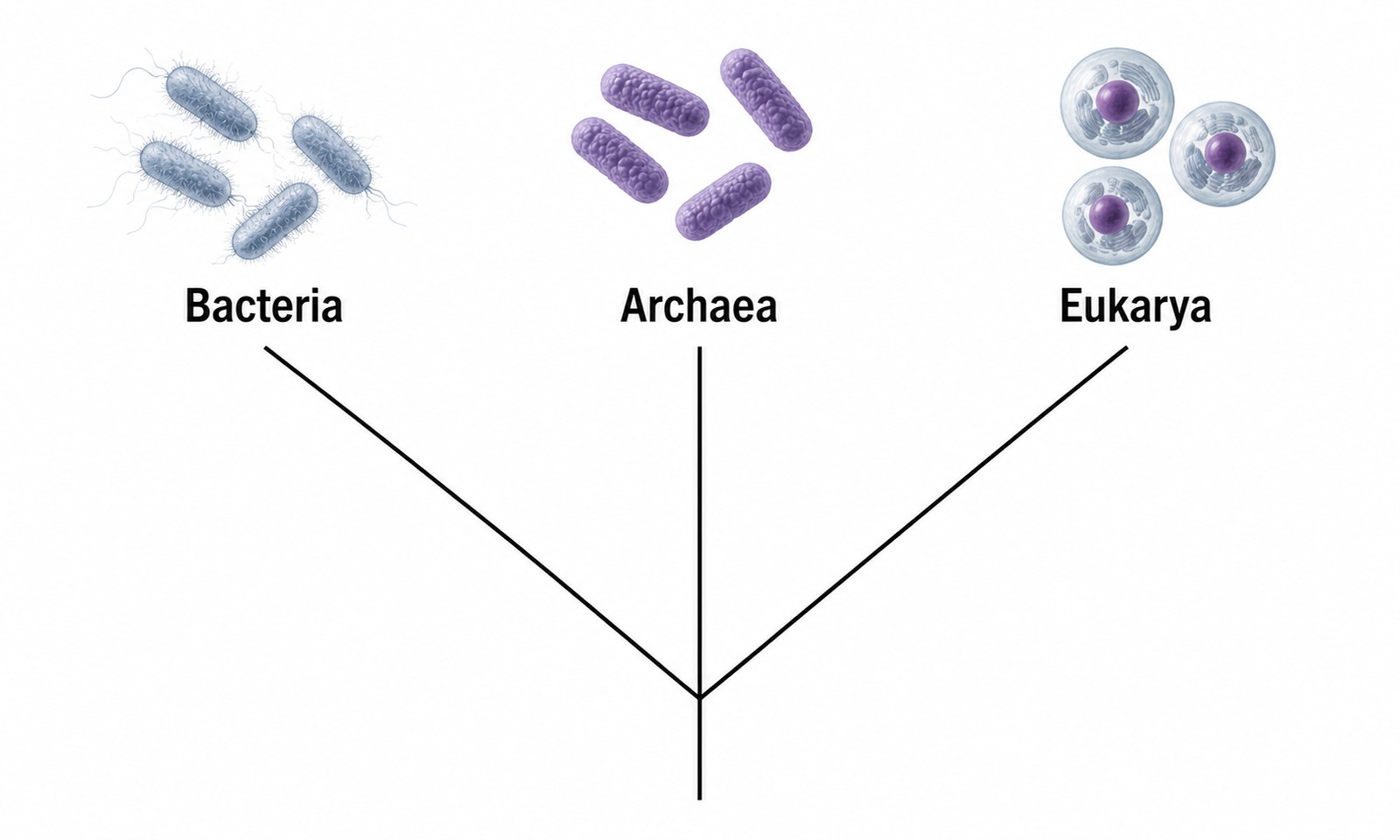
ABacteria
BEukarya
CArchaea
DPlantae
Explanation
Archaea are prokaryotes (no nucleus) and many live in extreme environments (hot springs, salt lakes, deep-sea vents). Bacteria are also prokaryotes but typically not extremophiles.
Question 9 of 10
In a DNA nucleotide, which component carries the genetic code through its specific sequence?
ADeoxyribose sugar
BHydrogen bond
CPhosphate group
DNitrogenous base
Explanation
The nitrogenous base (adenine, thymine, guanine, or cytosine) is the part of a DNA nucleotide that varies — its sequence along the strand IS the genetic code. The phosphate and deoxyribose sugar are identical in every nucleotide and form the structural 'backbone' of the DNA strand; they don't store information. Hydrogen bonds hold the two strands together at the bases but are not part of a single nucleotide.
Question 10 of 10
A student designed an experiment to test how light affects plant growth. Identify the components of this experiment. 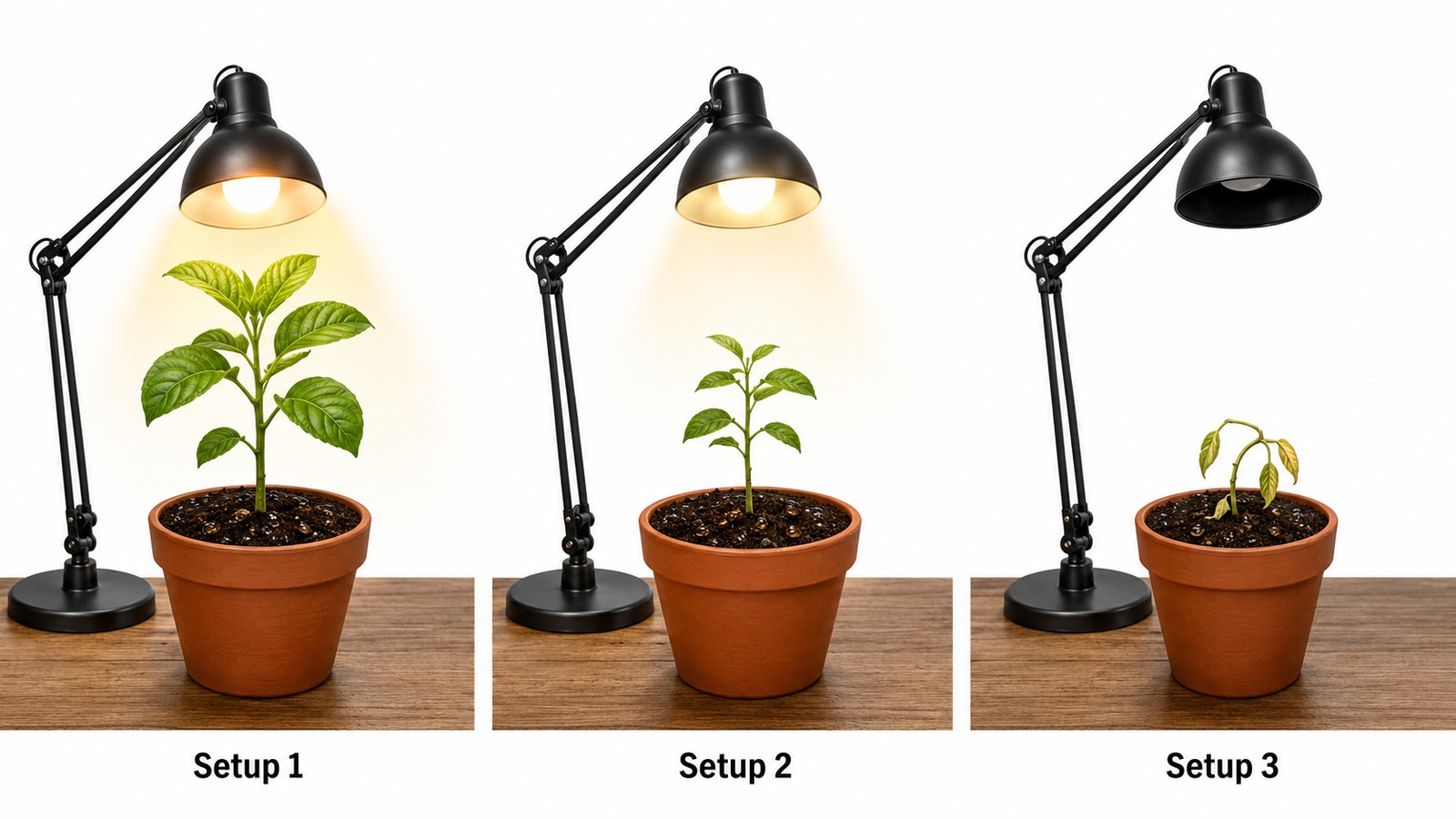
AIndependent: plant height; Dependent: light
BIndependent: water; Dependent: soil
CIndependent: light; Dependent: plant height
DIndependent: temperature; Dependent: light
Explanation
📌 Independent variable = what you change (light)
Dependent variable = what you measure (plant height)
Control group = no light (to compare against)
Constants = same soil, water, temperature, pot size
Dependent variable = what you measure (plant height)
Control group = no light (to compare against)
Constants = same soil, water, temperature, pot size